

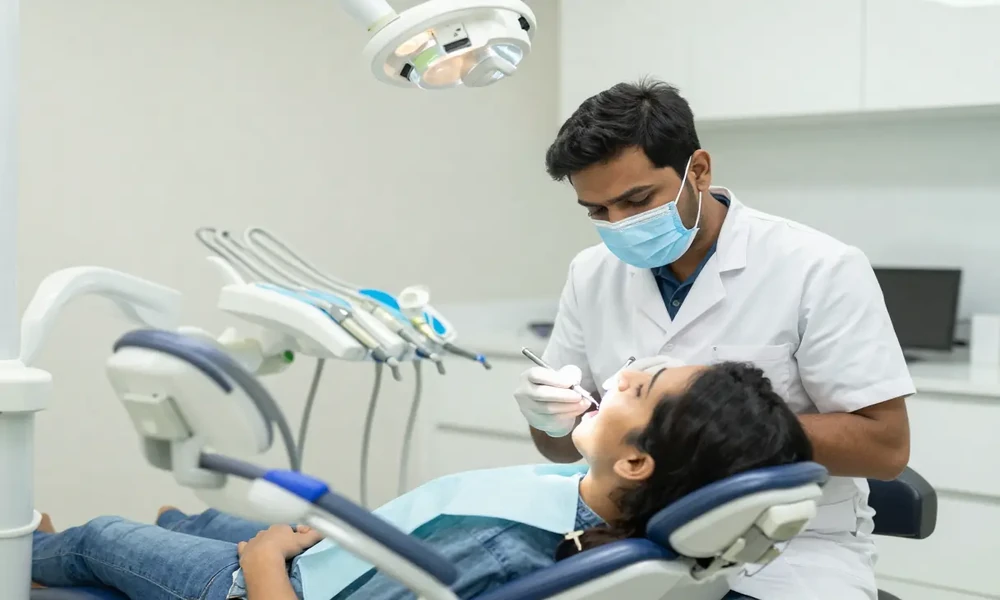
You sit down for cosmetic bonding expecting the tooth-colored material, the shaping, and the final polish. Then your dentist pauses to treat only part of the tooth surface first, and you may wonder why one small step gets so much attention. That concern makes sense. At a dental clinic serving Southwest Calgary, when you are already thinking about cost, appearance, and whether the bonding will hold up, every extra step can feel like something you should understand before anyone moves forward.
Selective enamel etching is one of those details that often happens quietly during treatment, yet it can affect how well bonding sticks and how clean the final margins look. In simple terms, the dentist places etching gel on the enamel, not broadly across all tooth structure, to improve the bond where enamel responds best. This approach is often used during cosmetic dental bonding because enamel and dentin do not behave the same way, and treating them the same can lead to weaker results.
Selective enamel etching supports stronger cosmetic bonding where it matters most
Enamel is the hard outer shell of the tooth. Dentin sits underneath, and it is softer, wetter, and more sensitive to technique. During a bonding procedure, your dentist is trying to create a durable connection between the tooth and the resin material. Selective etching focuses the acid on enamel first, which creates a surface the bonding material can grip more reliably.
This matters because a bonded edge that blends into enamel often needs both strength and beauty. If the margin stains early, chips too soon, or lifts at the edge, the result can look patchy even if the shade match was excellent on day one. You may only notice a tiny rough line at first. Then coffee catches there, floss snags, or the surface starts to lose its smooth feel. Small failures tend to start small.
Research supports the logic behind this step. A review of adhesive strategies in restorative dentistry discusses how enamel benefits from etching and why substrate-specific bonding matters. The American Dental Association also summarizes evidence on bonding agents and adhesive approaches in its evidence-based report on dental bonding agents, which helps explain why dentists may choose one method over another rather than using the same routine for every tooth.
Etching only the enamel can reduce common bonding problems
You may hear different terms for this. Some people call it enamel-only etching. Others refer to it as a selective acid-etch step. The idea stays the same. The dentist is trying to get the benefit of etched enamel without over-treating dentin.
That distinction matters in real life. If a front tooth has a small chip on the edge, the restoration may rely heavily on enamel for a clean, invisible transition. Selective etching can help create a crisp bond at that edge. If the tooth has more exposed dentin, the dentist may adjust the bonding method to protect the tooth and improve long-term performance. This is why a careful general and cosmetic dentist does not treat every bonding case as identical.
People often assume bonding is simple because it is conservative and usually faster than veneers. It is conservative, but it is not casual. The result depends on moisture control, tooth preparation, adhesive choice, layering, curing, and finishing. One rushed step can shorten the life of an otherwise good restoration. That is why tooth bonding etching is not just a technical extra. It is part of making the restoration last and look natural.
Selective enamel etching compared with broader etching approaches
| Approach | How It Is Used | Main Advantage | Main Concern |
|---|---|---|---|
| Selective enamel etching | Etching gel is placed mainly on enamel margins before the adhesive steps | Strong enamel bond with less risk of over-etching dentin | Requires precise isolation and technique |
| Total etch | Etching gel is applied to enamel and dentin | Strong enamel etch and familiar workflow for many dentists | Dentin can be more technique-sensitive, which may affect postoperative sensitivity or bond quality |
| Self-etch approach | Uses an adhesive system that etches as part of the bonding process | Simpler process and often gentler on dentin | May not etch enamel as effectively without added enamel etching |
For many cosmetic cases, selective enamel etching offers a middle path. You get the strong enamel conditioning that helps margins hold up, while the dentin can be managed with an adhesive strategy better suited to that tissue. That balance is one reason many dentists use it for front-tooth bonding, edge repair, and small shape changes.
What you can do before cosmetic dental bonding
Ask what surface is being bonded. A small chip mostly in enamel is different from a deeper repair that reaches dentin. When you know which part of the tooth is involved, the explanation for selective etching makes more sense, and you can better understand why one bonding approach was chosen over another.
Ask how the dentist plans to control moisture. Bonding does not like saliva, blood, or a wet field. Cotton rolls, suction, cheek retractors, or rubber dam isolation can all help. If the tooth is hard to isolate, that can affect durability as much as the bonding material itself.
Ask what to expect over time. Dental bonding is durable, but it is not permanent. Ask about staining risk, likely lifespan, polishing needs, and whether habits like nail biting or chewing ice could shorten the result. A clear answer helps you protect the work once you leave the chair.
Good cosmetic dentistry pays attention to the small steps
The small steps are often the reason a bonded tooth still looks good months and years later. If you notice your dentist pausing to etch only the enamel, that is usually a sign of careful planning, not unnecessary complexity. In cosmetic dentistry, subtle technique choices often separate a repair that merely fills space from one that blends in and stays put.
If you are considering bonding, ask for a clear explanation of the adhesive plan, the limits of the procedure, and how the dentist will help the restoration last. A thoughtful general and cosmetic dentist should be able to explain selective enamel etching in plain language and tell you why it fits your tooth.
